

If you have ever ended a set of deadlifts, rows, or shrugs because your hands opened up before your back or hamstrings gave out, you know the problem.
On heavy or high-volume pulling exercises, grip often fails first. Every set cut short by the forearms never fully reaches the muscles you were actually training.Gym wrist straps, more commonly called lifting straps, exist to reduce that limitation.
This guide covers what they are, when to use them, how to wrap them correctly, how cotton, nylon, and polyester compare, and what separates a strap that lasts for years from one that frays in months.
What Are Gym Wrist Straps?
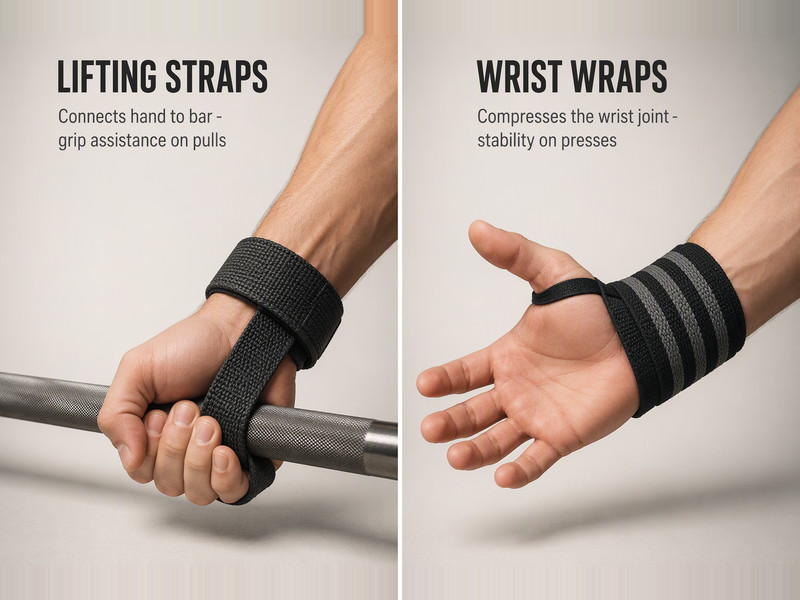
Gym wrist straps, lifting straps, and weightlifting straps all describe the same equipment: a length of woven webbing that connects your wrist and hand more securely to a barbell, dumbbell, or machine handle during pulling exercises.
A typical strap has a wrist loop, a strap body, and a tail that wraps around the bar, with optional padding and reinforced stitching at the loop and fold-back point.
The strap wraps under and around the bar so part of the load is carried by the webbing and transferred to the wrist. Your fingers still hold the bar but no longer carry all of the force.Lifting straps assist grip; they do not replace it.
Lifting Straps vs Wrist Wraps
Lifting straps provide grip assistance on deadlifts, rows, shrugs, and lat pulldowns, where grip fatigue is the limiting factor.
Wrist wraps are elastic bands worn around the wrist joint to add stability under heavy pressing such as the bench press.
Lifting straps help you hold the weight; wrist wraps help stabilize the wrist. If you are unsure how to position and tighten wraps, see our guide on how to use wrist wraps correctly.
What Do Lifting Straps Actually Do?
The most immediate benefit is reduced grip fatigue. When the hands tire before the lats, upper back, traps, hamstrings, or glutes, straps let the set continue until the target muscles reach meaningful fatigue.
They also create a more consistent connection with the bar, removing the slipping and readjusting that break concentration.
Straps may therefore allow more productive repetitions and help lifters focus on the back contraction instead of on holding on.
They do not make any muscle stronger by themselves. They simply let the target muscles keep working toward progressive overload when grip would otherwise end the set.
Main Types of Lifting Straps
Lasso or Loop Straps
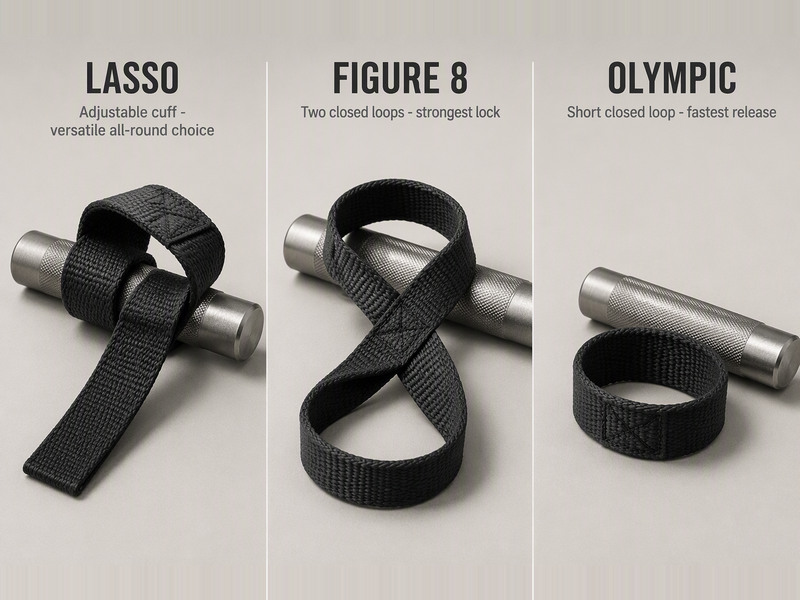
The lasso strap is the most common style: the tail threads through a loop to form an adjustable wrist cuff, then wraps around the bar.
It is versatile, beginner-friendly, and offers moderate locking strength, making it a sensible choice for deadlifts, rows, shrugs, pulldowns, and general training.
Figure 8 Straps
Figure 8 straps form two closed loops, one around the wrist and one around the bar, with the hand in the middle.
The lock is very strong but harder to release quickly, so they suit heavy deadlifts, rack pulls, and strongman events. They are not automatically better, simply more locked-in.
Olympic or Closed-Loop Straps
Olympic straps are short closed loops that release faster than any other style and lock in less than a Figure 8.
That quick release matters when a bar must be dropped safely, making them standard for snatch pulls, clean pulls, and Olympic lifting.
Cotton vs Nylon vs Polyester Lifting Straps
More durable does not always mean better for every lifter. Material choice should reflect training style, load, repetition range, sweat, comfort, and break-in.
Cotton Straps
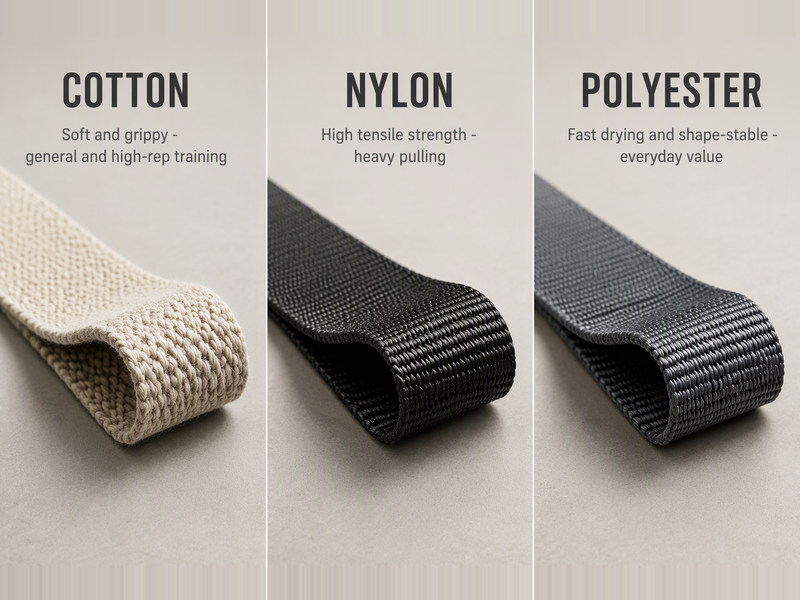
Cotton feels soft on the wrist, needs little break-in, and offers good dry friction against the bar.
It absorbs sweat, wears faster than nylon, and can behave differently once saturated, which makes it best for general training, bodybuilding, and high-repetition pulling.
Yarn quality, weave density, and surface texture still vary widely and strongly affect grip and durability.
Nylon Straps
Nylon offers high tensile strength, low stretch, and better moisture resistance than cotton, suiting heavy pulling and powerlifting-style training.
New nylon can feel slick, smoother weaves may need chalk or wear before grip improves, and stiff edges can feel harsh under heavy loads.
Strength alone does not guarantee grip; weave texture decides how securely the strap bites the bar.
Polyester Straps
Polyester delivers good value, dries quickly, holds its shape, and resists mildew, making it practical for commercial gyms and general fitness use.
Its friction depends heavily on weave structure, it is usually less soft than cotton and less strong than quality nylon, and lower-grade webbing can deform under repeated loading.
Padded vs Non-Padded Straps
Padded straps, often using neoprene, distribute pressure and can improve comfort during high-volume training.
But excess padding adds bulk, shifts under load, and dulls wrist feel. Non-padded straps are leaner and easier to tighten; more padding does not mean more comfort.
Common Lifting Strap Myths
Thicker straps are not always stronger. Real strength comes from fiber quality, weave density, and reinforcement at stress points, so a thinner high-density strap can outperform a thick, lower-grade one.
Nylon is not always better than cotton, because stronger does not mean more suitable for high-volume work.
Material alone does not determine quality. Weave, stitching, width, length, and loop size decide how a strap performs.
When Should You Use Lifting Straps?
Use lifting straps when your grip is failing before the muscles you are actually trying to train. In practice, that usually means:
- Heavy working sets of deadlifts, rows, Romanian deadlifts, and rack pulls
- High-repetition pulling such as dumbbell rows, shrugs, and pulldowns where forearm fatigue arrives first
- Later sets in a high-volume session, once forearm fatigue has built up
When Not to Use Lifting Straps
Warm-up sets are a free opportunity to train natural grip, so leave the straps off. Skip them during dedicated grip work such as dead hangs or farmer’s carries.
Straps are an overload tool, not a replacement for grip training, and should never hide a poor setup or flawed mechanics.
Should Beginners Use Lifting Straps?
Yes, but strategically. Lifting straps do not weaken your grip; overdependence does.Beginners should first build proper grip mechanics, correct technique, and basic forearm strength under controlled loads.
Once technique is stable, use natural grip for warm-ups and moderate sets, and reserve straps for heavy or high-volume work. For palm protection during this phase, gym gloves are often a better starting point.
How to Use Lifting Straps Step by Step
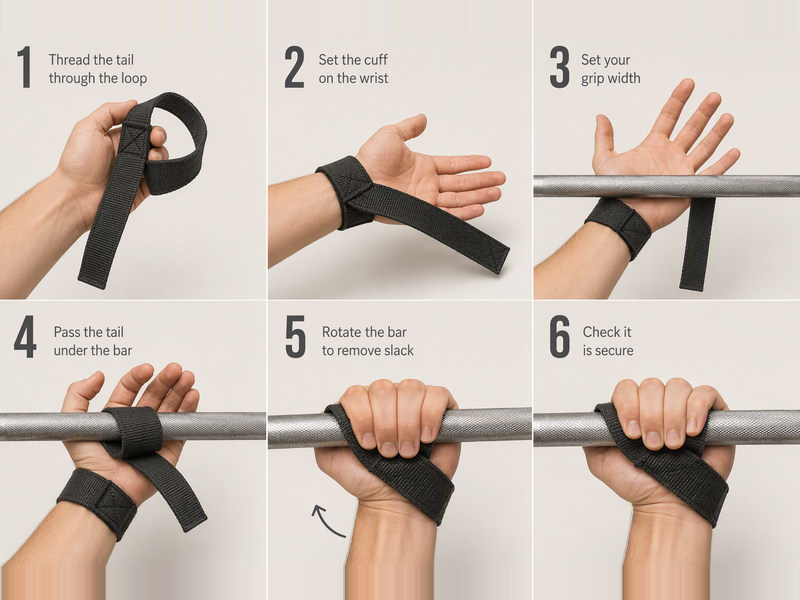
Wrapping a lasso strap correctly takes only a few seconds once the pattern is familiar:
- Thread the tail through the loop to form the wrist cuff.
- Position the cuff snugly on the wrist with the tail over the palm, matching on both hands.
- Set your grip width on the bar before tightening.
- Pass the tail under the bar first, then around it, following the direction your fingers close.
- Lightly rotate the bar toward you, like turning a throttle, to remove slack.
- Confirm the strap is secure and you can release safely.
How Tight Should Lifting Straps Be?
Secure, but not painfully tight.
Around the Wrist
The cuff should feel snug and stable without cutting circulation, pinching skin, or creating pressure points.
Around the Bar
Remove enough slack that the strap does not slip, but not so much that release becomes difficult or the wrist takes excessive pressure.
Adjusting for Different Exercises
For deadlifts, wrap evenly, remove slack, and brace before pulling.
Romanian deadlifts fatigue grip quickly because of long time under tension, so straps become useful earlier.
On barbell rows, keep the wrist neutral so the back does the work; for dumbbell rows, secure the strap before entering position.
Lat pulldowns rarely need an aggressive lock, while shrugs and late-session pull-ups benefit whenever grip endurance runs out.
Common Lifting Strap Mistakes
Wrapping in the wrong direction is the most frequent error and causes the strap to loosen under load.
Too much slack reduces security, a cuff worn too high or too low shifts pressure, and over-tightening makes release difficult.
Using straps on every set removes the chance to build natural grip, using them to hide poor form delays the fix, and ignoring worn stitching creates a hazard.
What Makes a High-Quality Lifting Strap?
Two lifting straps can look almost identical in product photos and perform very differently under load.
Stitching matters most. Reinforced bar-tack stitching at the loop opening, fold-back point, and load-bearing seams is critical, because the webbing is rarely the first part to fail — poorly reinforced stitching is.
Width. Around 1.5 inches (38 mm) is a common width for lasso straps, though not a universal standard. Too narrow concentrates pressure on the wrist; too wide adds bulk and is harder to wrap.
Length. Length sets how many wraps you can make, so too short limits locking and too long leaves excess tail.
For brands developing their own line, these construction details are exactly where OEM lifting straps differ from generic stock products.
Cleaning, Maintenance, and Replacement
Hand wash straps in cool water with mild soap, air dry away from heat, and never machine dry, which can shrink cotton and stiffen nylon.
Inspect the loop, seams, and edges regularly, and replace any strap with broken stitching, fraying, or a loose loop.
Frequently Asked Questions
Do lifting straps weaken your grip?
Not by themselves. Straps only reduce grip demand on the sets where you use them. Grip gets weaker when straps are used on every set, including warm-ups and light work. Keep warm-ups and moderate sets strap-free and grip strength keeps developing.
Are lifting straps allowed in competition?
It depends on the federation and the lift. Most powerlifting competitions do not allow straps in the deadlift, and Olympic weightlifting does not allow them in the snatch or clean and jerk. Straps are primarily a training tool. Always check the current rulebook of your specific federation.
What is the difference between lifting straps and wrist wraps?
Lifting straps connect your hand to the bar and solve grip fatigue on pulling movements. Wrist wraps compress and stabilize the wrist joint for pressing movements such as the bench press. They solve different problems and are not interchangeable.
Which lifting strap material is best?
There is no single best material. Cotton suits general training and high-repetition work because it is soft and grips well when dry. Nylon suits heavy pulling because of high tensile strength and low stretch. Polyester is a practical mid-range option that dries fast and holds its shape.
How long do lifting straps last?
It depends on training frequency, load, sweat exposure, and build quality. The failure point is almost always the stitching at the loop or fold-back point, not the webbing. Inspect those areas regularly and replace the strap once you see broken stitching, fraying, or a loose loop.
Can beginners use lifting straps?
Yes, but strategically. Build basic grip mechanics and forearm strength first under controlled loads. Once technique is stable, keep natural grip for warm-ups and moderate sets, and use straps for heavy or high-volume pulling.
Conclusion
Lifting straps are one of the simplest tools in strength training, but they reward thoughtful use.
Choose the style and material that match your training, wrap them correctly, and save them for the sets where grip genuinely limits you.
Inspect the stitching before trusting them with a heavy pull. Used this way, straps help your back, traps, and hamstrings get the training they deserve without costing grip strength.
Building a strength training product line?
Explore our cotton, nylon, and padded lifting straps, built with reinforced bar-tack stitching for consistent grip under load — or talk to our team about OEM and ODM customization.